
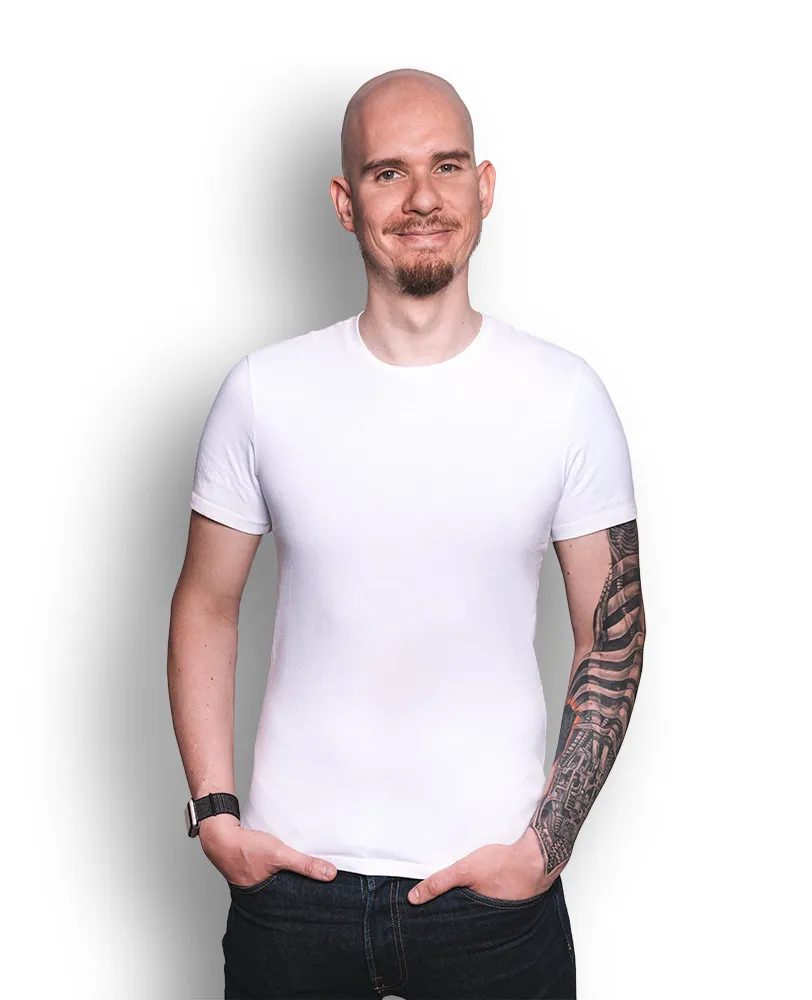
Hi, I'm Michael. I have no self control.
In short I built I Have No Self Control for my own brain. It began as an app that punished missed goals and ended as one that interrupts: when my daily budget for the apps that pull me in is used up, past me asks whether more is worth a small, physical price. This is how it got there, what I needed from it, and why it will cost money.
The app’s name is a confession, not a diagnosis. I was diagnosed with ADHD at 39. Every autism screening I have taken ended with the recommendation to get a proper assessment; I haven’t had one yet, so autism is suspected, not diagnosed. And I lose hours to my phone, the way I have lost hours to almost everything that makes it easy.
This is the long version of how an app came out of that. It is personal, it is about my brain and nobody else’s, and it promises nothing about yours.
It started as a punishment app
The idea came while I was thinking about a different app, one I am also working on and can’t talk about yet. That one needs accounts and stores data about people, and data about people brings the GDPR straight along. I didn’t want to get into legal trouble over a vague idea, and I have a real problem with shipping anything that isn’t done properly.
The idea for this one came in the car. I had ChatGPT running in CarPlay as a spoken conversation (thanks to the Freakshow podcast for the tip that this works), and the first version looked nothing like today’s app. You would set yourself goals, and when you missed one, you would take a punishment you had chosen yourself: a payment, a public embarrassment, something that stings. My claim at the time was that the fear of losing drives us harder than the hope of winning.
Somewhere in that conversation I added my phone to it. Set yourself a maximum for the apps you waste time in, and when you go over it, pay to keep using them. It turned into something you could call willpower as a service: you decide now what your future self will do, and the app makes sure your future self can’t talk its way out of it cheaply. Still all about punishment.
Four digits
Then ChatGPT mentioned Apple’s Screen Time, and I went off on a rant.
Screen Time, and its parental controls in particular, is one of the least successful parts of iOS I know. My wife and I have two children, and we fight with it constantly. When a child asks for more time, we can approve 15 minutes, 1 hour or all day [1]. The settings are complicated and hard to understand, and in our house, what we set on one device doesn’t reliably reach the other.
In the middle of the rant I realised why I barely use Screen Time for myself. The steps are far too coarse, and in my experience all that stands between me and more time is my own Screen Time passcode. It has 4 digits [2]. My ADHD brain, deep in a feed, laughs at 4 digits. There have to be real hurdles: moving, putting the phone down altogether, going outside, using a different app, jumping around. If you have seen the rest of this site, that list will sound familiar.
A bit of research showed that Apple had opened Screen Time to other developers’ apps only in 2021, and then only to parental-control apps [3]. A lot of it was unclear, so I built two small test apps with Claude Code, one for iOS and one for Android, to find out what an app can really control and how. The answer: it works, with limits, more of them on iOS.
If I’m going to escalate anyway
Slowly a concept took shape that is close to what the app does now. I set myself a daily budget for a group of apps. When it’s used up, a curtain comes down over those apps, and the app offers me what I set up earlier as the price of more time. The first list of ideas for that had sixteen kinds of price: wait 2 minutes, put the phone away for 10, 10 minutes in Duolingo, 500 steps, 20 jumping jacks, walk 300 metres, leave the flat, scan a QR code in the basement, climb 2 floors, a photo of the tidied desk, a photo of the bin, 3 minutes of vacuuming, a parent or partner approves, €2, a 5-minute delay, or 10 minutes of learning for 20 minutes of games. Only some of them made it into the app. Paying money didn’t: my own research talked me out of it.
The vacuum fascinated me most. I simply found it hilarious that my iPhone can hear a vacuum cleaner running, even if it now and then takes it for a hair dryer [4]. And it dawned on me that this might leave me with a slightly tidier home, all because I wanted a few more minutes of TikTok in doomscrolling hell.
I know from experience that I won’t manage to stay away from these apps by self-control. Maybe that isn’t even the goal. Staying away is restriction, and my ADHD brain hates restriction with a passion. So I turned the idea around, away from control and towards this: if I can’t leave it alone, at least interrupt me now and then, and give the interruption a chance to be something worth doing. If I’m going to escalate anyway, then at least halfway under control.
Now and not now
Then the research began, because I had to get from an idea for forcing myself into something to something I could actually accept and respect.
There is a term I recognise myself in: Pathological Demand Avoidance, PDA for short. I know the pattern far too well. A demand that comes at me from outside doesn’t make it more likely that I do the thing; it makes it less likely, sometimes to the point of complete paralysis, even for things that have nothing to do with the demand. I have spent my whole life forcing myself into everything that isn’t fun, and that is a lot of things. I don’t mean pull yourself together a little. I mean that every small task feels like climbing Everest. I envy people who can simply decide to do an unpleasant thing and then do it, without a gun to their head. It doesn’t work like that for me.
I don’t want to go too deep into ADHD here, but doomscrolling is part of it for me: hours of content that deliver the cheap kick my brain craves, and with them, time disappears. Time and I don’t have a warm relationship anyway. For me there is now and not now, and not now is irrelevant, far away or long gone. The further something is from now, the more abstract it gets. It really feels like glancing at a clock, blinking, and when my eyelids come back up, three hours have passed, I’m suddenly starving and urgently need the loo.
That is where the app comes in. Before the next blink, even my brain can agree that it would like a limit. Phones can do that, so I set one. And I learn fast: the interruption means only an hour has passed instead of three, but the code that buys the next hour is far too easy to type. Awareness alone isn’t strong enough to break whatever I was doing for that hour.
There is another thing about me here: if it isn’t physical, it isn’t real. An interruption needs an anchor in the physical world. Switching from something that feeds me to something that doesn’t is slow for me and takes an enormous mental effort. It works better when I am made to put the first thing down, especially for something I don’t completely hate. So if I want to interrupt the scrolling, I need something physical to take its place for a moment. It has to be short, and it has to be now: not abstract, not in a few hours, not a mental task, and above all nothing that takes willpower, because right then I have less of it than usual. It’s a vulnerable moment, and the app has to get me to do something else in it.
In my experience that works best without reproach, without you’ve overdone it again, without any judgement between the lines. People with ADHD hear a lot of criticism; I certainly have, all my life. The sense of failing all the time is always there. I don’t need an app to rub it in.
Past me said no
That’s how past me, present me and future me came about. My idea: if the app doesn’t speak to me itself, but my past self speaks to me through it, that might be different. To be angry at it, I would have to be angry at myself. Don’t get me wrong, I often am. But I would still rather respect what past me decided. I’m kinder to myself than to an app.
The app holds to that everywhere. No reproach, no judgement, no shame, no just pull yourself together, nothing forbidden and nothing ordered. Instead, plain facts, calmly, in past me’s words: Past you said no. I have a choice, and I don’t have to take any of it. If I do, the only thing I have to accept is that the scrolling doesn’t go on right now, and that I can do something else first.
The kitchen
And the something else is what I want to be moved to, because then I find out quickly that other things can be fun too.
Say I pick scanning the code in the kitchen. So I get up from the couch. With a bit of luck, I notice the dishes in front of me on the way, and take them along. In the kitchen I put them down, and maybe I even put them in the dishwasher, and notice other things that belong in there. And while I’m at it, I might clear away the stuff that’s in the way. A small spiral of getting things done, which sometimes ends with one empty glass from the coffee table on the kitchen counter and sometimes with a completely clean kitchen.
At the end I scan the code. Or I’ve put the phone down somewhere and forgotten it exists, because object permanence is another thing I know far too well: if I can’t see it, it doesn’t exist, and my memory deletes it from the short-term buffer. Including where it is. Then it’s time for the best feature of the Apple Watch, the one that makes the iPhone announce itself loudly. How it ended up in the children’s room will remain a mystery forever. Never mind: at least there are no dirty dishes in the children’s room now either.
Let’s call it character
So I decided to try pouring all my experience and my personal preferences into an app, and to make it the tool that I believe represents me, understands me and respects me.
But I couldn’t leave it at my preferences. If I’m doing this, I want evidence for my anecdotes, to back them up, or to set them aside as unprovable or as provable nonsense. Facts beat feelings. So research has gone along with every step of building the app, and some of it has turned into articles on this site.
Where the evidence was thin or contradictory, I still had to decide, and then I always went with my own preference. I’m the one who is supposed to use the app. Those decisions can only be good for me; for someone else they may be annoying or even a red flag. It is what it is. Let’s call it character. I hope I wasn’t too far off at least a few times.
The result is this app. I designed, researched and built it with a lot of help from AI: Claude Code for the code and the platform experiments, AI research tools for finding and reading the papers. It has grown surprisingly large, and I have learned a lot along the way. I hope I’m not the only person who turns at least some doomscrolling into a tidier home with it.
Why it will cost money
I would love to give the app away. Three things stop me.
First, rents and living costs are rising fast, and every day I don’t put into earning money catches up with me sooner or later. I hate it, but that’s how it is.
Second, and more important to me: I read Skin in the Game by Nassim Nicholas Taleb, and it left its mark. Think what you like of him as a person; the ideas in the book are valuable to me. One of them is that a thing only becomes truly valuable and real once something had to be given up for it.
My preference
I believe a price is part of what makes the app work: that paying for it is part of why someone takes it seriously. That is my conviction, not something I can show you a study for.
Third: if it’s free, you are the product. While building the app I decided I would not run a data octopus. The app collects nothing it doesn’t need to work. What it records stays on your phone: nothing goes to a server to be collected or analysed, and the version in the App Store has no way of its own to send it anywhere. There are no ad partners either, and there never will be. (My lawyer would want me to add that whatever I write here, what counts is the privacy policy.)
I pay enough ADHD tax already, including by handing over my personal data without meaning to, to an advertising machine that knows exactly how to set off my brain to sell me something. I don’t want to call that fraud or unethical; that’s a long philosophical discussion for another place. I just want to be as small a part of that machine as I can, and never expose the people who use my app in a way they didn’t intend. Nobody manages their screen time for fun. You do it because you have recognised a problem for yourself. Letting advertisers reach the people who use this app would mean that the mere fact of using it says something about them that could be used against them. Not collecting data also means no trouble with the GDPR, and data that is neither collected nor stored centrally can’t leak from servers I run.
As for how the app will be paid for, I’m leaning towards a subscription. I know many people hate subscriptions, and I partly understand why. I know I will lose users over it. But there’s one thing I want to know about the people who use the app: how happy they are with it. I could run the nicest surveys, but in the end people vote with their feet or with their wallet. They leave, or they stop paying. The second is easy to see: how many downloads turn into subscriptions, and how long the subscriptions last. If 95% of people drop out after the first month, that says clearly that the app doesn’t do what I built it for. As a millennial with two children, I’m not in a position to keep a hobby project going for its own sake. It would have been an instructive project, and maybe not one worth continuing.
My preference
I prefer subscriptions to one-off payments myself. Paying regularly keeps developers able to improve their software and keep it working with new versions of the system and new hardware, and apps that use Screen Time need that with almost every iOS release. And I’d rather pay a small amount while I find out whether an app is for me than a large one up front. If I had paid in full and never opened the app again after four weeks, that would annoy me more than a few months of small payments.
One thing speaks against a subscription, and it’s the same ADHD tax: some people will forget to cancel. The people I build this for are the ones most likely to forget, and I miss the opposite in many apps myself. So if it becomes a subscription, I won’t build a subscription trap, not by accident and certainly not on purpose:
- Before each payment, the app reminds you that it’s coming, while there’s still time to cancel, as far as Apple lets an app do that. You can switch the reminder off; I get enough notifications as it is.
- Managing the subscription happens inside the app, and it’s easy to find.
- Cancelling is as simple as Apple allows.
That will probably cost me a fair amount of money. So be it. A one-time purchase isn’t ruled out later; it just doesn’t fit this phase.
Some will say I don’t have to explain any of this. But I want to.
Sources
- Apple. Approve your child’s purchases, downloads, and Screen Time requests. Apple Devices for Kids and Families. support.apple.com. Accessed 2026-09-27. Platform documentation↑
- Apple. Create, change, or remove a Screen Time passcode on iPhone. iPhone User Guide. support.apple.com. Accessed 2026-09-27. Platform documentation↑
- Apple (2021). Meet the Screen Time API. WWDC21. developer.apple.com. Accessed 2026-09-25. Platform documentation↑
- Fuchs. The built-in sound classifier recognises a vacuum cleaner on the device, iPhone 17 Pro Max, iOS 27.0. Own measurement↑
This site belongs to an iPhone app: a daily limit on the apps that pull you in, and a price on more time, both set by you earlier. See how it works